
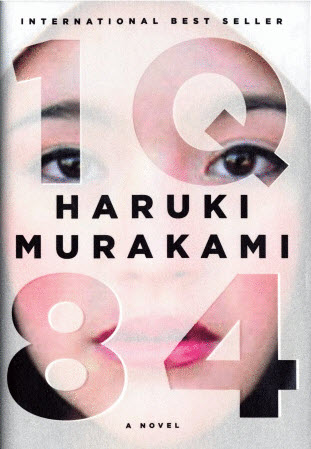
1Q84
By Haruki Murakami
(Knopf, Hardcover, 9780307593313, October 2011, 944pp.)
The Short of It:
1Q84 is a literary mash-up of epic proportions. The artistry of the writing will impress Murakami’s die-hard fans, but I suspect that he will gain a whole new following with this one.
The Rest of It:
On a busy expressway, Aomame steps out of a cab and slips into a parallel world. Initially, the fact that she’s entered another world goes unnoticed by her, but slowly she begins to realize that although this new world is similar to what she had before, there is something about this new world that she can’t quite put her finger on. At times, she sees two moons in the sky and wonders if she is the only one who can see them. What do they mean? She calls this world, 1Q84…the Q, representing a question mark. It is a “world that bears a question.”
Meanwhile, Tengo has been asked by his editor to ghostwrite a work titled, Air Chrysalis. The work was written by a young girl named Fuka-Eri and although the story is impressive, the technical aspects of the writing are less so. An aspiring writer himself, Tengo finds himself somewhat obsessed with the young girl and the two form a very unusual friendship.
As the chapters alternate between Tengo and Aomame, you realize that at some point these characters will meet. In fact, they have already met once, as children. An encounter that Tengo and Aomame have never forgotten and one that is played out repeatedly throughout the book. Neither of them can explain their inexplicable desire to find one another because the fact that they are drawn to each other is odd enough. As they make their way towards each other, they encounter obstacles and unforgettable characters along the way.
If you noticed that ‘1Q84’ resembles the title of another landmark novel, ‘1984’ then you would be correct in thinking that there is a connection between the two. This novel is Murakami’s ode to Orwell. In 1984, you have Big Brother and in this novel, the Little People. The two books share similar themes but the feel of each is quite different. In many ways, Murakami is more matter-of-fact with his storytelling. For the most part, his characters say what they mean. They are open books. The reader is always clued in to what they are feeling at any point in time. However, the meaning behind what they are feeling, is often left open for interpretation. This is one of the reasons I love Murakami. His ability to put it all out there, trusting that as a reader, you will come to your own conclusions is a tough thing to do. The confidence that he has in his readers is something I have felt from day one. It’s no wonder that his fandom continues to grow daily.
I’ve read five books by Murakami and if I were to compare this one to them, I’d have to say that this one is tamer. There is less sex, less strangeness, but the themes dealing with identity, belonging, violence against women, religion, re-birth, Oedipus complex…are all here, but handled in a quiet way. It’s not nearly as bizarre as some of his other novels. No talking cats, for instance. But it is most definitely a Murakami in the handling of the characters. The characters are often likable, and that is also the case here. However, they are not predictable. As you read the novel, you begin to get a feel for them, but you can never truly know them because they are very complex. Murakami’s characters are never flat. They are constantly evolving and that is something I look forward to every time I open a Murakami book. The other thing that is pure Murakami, is that there are no “throw away” characters. They all have a purpose, no matter how silly or trivial they may seem at first glance.
I was very sad when I turned the last page. I didn’t want it to end. I wanted to crawl inside the book and become one with it. It was wonderful and thought-provoking on so many levels. It’s totally accessible even at its 944 pages and there is never a dull moment. I was worried about the translation, as it took two translators to get the job done, but I looked for style differences and they were none to speak of. If they existed, I never noticed them. With its “love story in a parallel world” premise, there is something here for everyone. I honestly don’t think it even matters if you haven’t read any of his other books. This one might even be a good book to start with because it eases you into his writing style and if you like books that question reality as we know it, then there is no doubt in my mind that you will enjoy this one.
That said, I could write pages and pages on why you should read it, but I’d rather you just trust me in saying that if you do read it, you won’t be sorry.
Source: Purchased
Disclosure: This post contains Indiebound affiliate links.
 Book Chatter