
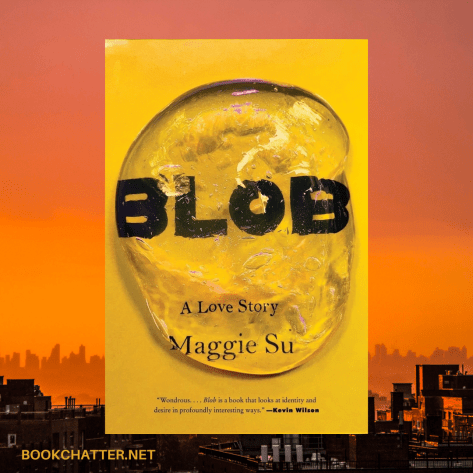
Blob: A Love Story
By Maggie Su
Harper, January 2026, 256pp.
The Short of It:
Wild and unbelievable and yet fascinating.
The Rest of It:
Vi has always lived just outside the circle.
At work, she hovers at the edge of conversations. With friends, she’s the afterthought invite. In relationships, she’s the one who tries harder. No matter the room, no matter the people, Vi is always almost in, but not quite.
Then one night, she steps outside her apartment and sees it.
A blob.
Translucent. Gently pulsing. Breathing, somehow, beside the dented trash can. It looks like a jellyfish stranded without water, faintly luminous under the flickering security light. It shouldn’t exist. It definitely shouldn’t be alive.
Vi stares. The blob quivers.
She goes back inside.
But she can’t stop thinking about it.
When she checks again, it’s still there—only now it seems slightly different. Larger?
Against her better judgment—and possibly against all common sense—Vi takes it home.
Recently dumped and painfully untethered, Vi isn’t sure what she has to offer a mysterious gelatinous lifeform. Still, she makes space for it in her tiny apartment. She feeds it. Talks to it. Names it Bob. She teaches Bob how to mimic her—how to stretch, to balance, to grow something resembling limbs.
And Bob learns.
Fast.
Soon Bob the Blob isn’t just pulsing near a storage bin. He’s developing arms. Legs. A torso. A very attractive torso. With each lesson Vi gives him, how to speak, how to move, how to smile, he becomes more human. More independent. More aware.
And harder to control.
Because free will, it turns out, isn’t something you can selectively grant.
As Bob grows into something dazzling and dangerously charismatic, Vi is forced to confront what she’s actually created. Was she trying to build companionship? Control? Someone who wouldn’t leave?
Meanwhile, there’s Rachel. Vi’s relentlessly cheerful coworker. The kind of woman who brings homemade muffins on Mondays and somehow means it when she asks how you’re doing. Rachel is everything Vi isn’t: socially fluent, effortlessly included, suspiciously happy.
Vi doesn’t know whether she wants to be Rachel… or prove she’s fake.
Between managing Bob’s rapid evolution and navigating her own spiraling insecurities, Vi begins to understand something uncomfortable: independence isn’t the same thing as fulfillment. Being alone doesn’t make you strong. Sometimes it just makes you lonely.
Bob may be otherworldly, absurd, even a little ridiculous—but what he ultimately reflects back to Vi is painfully human. We are not built to exist in isolation. We can pretend we don’t need anyone. We can wear independence like armor.
But connection is not weakness.
It’s survival.
Fantastical, sharp, and darkly funny, this story explores loneliness, belonging, and what happens when you try to engineer love instead of risking it.
Recommend but you must go in with an open mind.
Source: Borrowed
Disclosure: This post contains Bookshop.org affiliate links.
 Book Chatter