
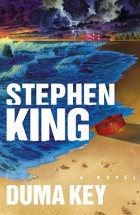
Duma Key
By Stephen King
(Scribner, Hardcover, 9781416552512, January 2008, 624pp.)
The Short of It:
Once again, King pulls you in with his vivid imagination, colorful characters and wry sense of humor. This is “classic” King.
The Rest of It:
I’ve got a thing for King. I like to read him in between my heavier reads, and I always save him for long breaks. I spent my July 4th weekend curled-up with Duma Key, and let me tell you, it was wonderful!
After surviving a construction accident that nearly kills him, Edgar is forced to come to terms with his new life. Left with one arm and angry as all get out, Edgar is not pleasant to be around. His wife has decided to leave him, and his grown daughters aren’t sure what to make of their new dad. On the recommendation of his doctors and close friends, Edgar rents a house on Duma Key’s Florida coast. There, his phantom arm continues to remind him of what was, but he gains a skill which he never had before; he becomes an artist. At first he is startled, but as the paintings begin to tell a story, he becomes frightened.
Why I loved this book:
- Memorable characters. This may be my favorite King yet. I fell in love with Wireman and Jack. These are Edgar’s friends on Duma and they make this good read, great.
- The setting. The sounds of the ocean, the color of the sunsets all play a role in this story. I had no trouble visualizing Duma Key’s strip of coastline and that’s saying a lot because Duma Key does not exist.
- Very little gore. I know a lot of you shy away from King because you have this image in your head that he is all about gore. That’s not true. Yes, he does have a vivid imagination and his stories often have horrific scenes in them, but he plays upon your insecurities and he does it well. That’s why his books have the effect that they do. Given what I just said, the images created in this one are very mild compared to some of his other books. Mild, but still memorable.
- There’s supernatural stuff going on. Some ghostly in nature, a bit of intuition and a lot of premonition.
- There were no slow spots. This book is a chunkster, weighing in at 600+ pages yet I didn’t notice its length at all. It was steady reading throughout and there were many times where I didn’t want to put it down.
- It’s “classic” King. Meaning, it’s the way he used to write when I first started reading him (late 80’s). After his accident in 1999, which involved being struck by a minivan, countless operations and several physical therapy sessions, his books took on a different tone. I didn’t care for that tone. I still read his work because I am a constant reader (what he calls his fans) but I didn’t care for it. Duma Key, was written at the end of that phase (imo) and he returned to his classic style of writing.
When I mentioned that I was reading this one, a lot of you said that you were looking forward to the audio version. I imagine it would be wonderful on audio, but there is something special about reading a book like this and picturing these characters yourself. Yes, I know you can do that with audio (to a degree) but I’m sure my image of Wireman would be completely different on audio. It would be an interesting test, that’s for sure.
Needless to say, I added this to my list of faves for this year even though it’s not literary or considered one of those “must-read-before-you-die” books. I am adding this one purely for the characters. I was so sad to say goodbye to them.
Source: Borrowed.

Disclosure: This post contains affiliate links.


 Book Chatter