
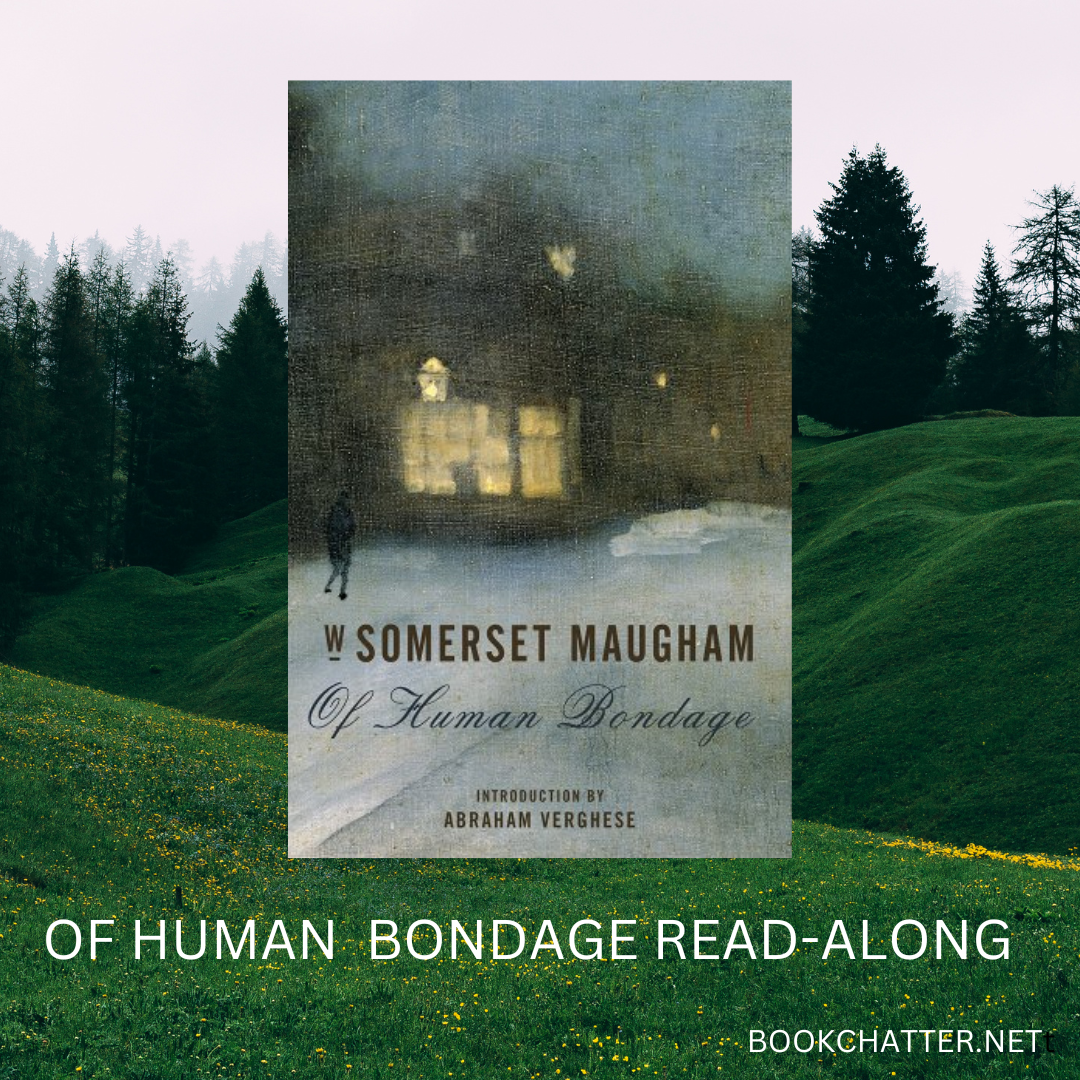
It’s Friday and the end of Week 2! Of Human Bondage is really picking up now. Many of you have mentioned its likeness to a Dicken’s novel and I would agree, minus the dark, depressing bits.
By now, you should have read the following but of course you can read it at your own pace. This week we are discussing this section:
Chapters XV-XXI / 15-21 (40 pp.)
Chapters XXII-XXXI / 22-31 (43 pp.)
Chapters XXXII-XXXV /32-35 (30 pp.)
Chapters XXXVI-XXXIX / 36-39 (22 pp.)
Discuss/Read the above by 10/11 (135 pages total)
Click here for the full schedule.
Week 2 – So Much Has Happened
A new headmaster is appointed, Tom Perkins. The first thing said about him, “he was not a gentleman.” As a child, given scholarships due to his brilliance, he went on to complete his schooling and now he’s back at Tercanbury as the headmaster.
Philip is assigned to Mr. Gordon’s class. Mr. Gordon is big on punishment of the physical kind but once Headmaster Perkins arrives, his acts are somewhat tempered so he resorts to flat-out name calling. Philip becomes the “club-footed Blockhead.” Headmaster Perkins sees Philip’s intelligence and the two form a bond.
Huge news. After a critical conversation with headmaster Perkins, Philip decides to become ordained. Perkins asks Philip to consider his physical condition a cross to bear and that God would not have allowed it unless his shoulders were strong enough to bear it. Hmmm. I mean, his deformity really wouldn’t matter in that line of work. Sounds like a plan.
Although Philip revels in the relief of knowing what he wants for his future, his time at school is still plagued by awkwardness and loneliness. The latter his own doing. He much prefers his own company but when he meets a lad named Rose, he is slowly introduced to what the other more popular accepted boys, experience. Rose and Philip become inseparable.
That is until scarlet fever comes to town. Philip is hit with it but after a schoolmate dies from it, everyone at school is rearranged and Philip is no longer in the same study as Rose. Jealousy sets in.
All the business with Rose puts Philip in a sour mood which eventually takes its toll on his studies. Mr. Perkins tells him clearly that his scholarship is at stake and that he better begin to care because up until this point, he has not.
But Philip decides to quit school and head to Germany. He is very firm on this and then not so firm, saying that if the headmaster really pushed it, he’d change his mind and stay. He’s a boy who really has no clue about his future.
Philip leaves for Germany. His Aunt arranges lodging for him, with a Professor, and two young daughters. The Professor sets him up with different professors, one of which is Wharton, deemed a math professor but really a professor of life. No math is taught.
This part of the story gets a little murky. Many characters are introduced. All professors of some sort. All of them traveling and coming and going. Philip seems taken with Hayward, but Philip is taken by many who buck the system and travel the world.
A heated conversation with Professor Weeks causes Philip to question his faith. Suddenly, he declares that he doesn’t believe in God and he’s okay with whatever punishment comes from that. But then he realizes without faith, he won’t ever see his dear, dead mother again.
Philip is called back home by his Aunt Louisa. When he returns, he finds Miss Wilkinson there. The lady who arranged lodging for him in Germany. But for whatever reason he never met her while in Germany. As he gets to know her, his affection grows.
The relationship is an impossible one. Miss Wilkinson is much older than Philip. Caught up in the passion of it all, they overstep their boundaries and then off they go. Separate ways.
Philip heads to London to become an articled clerk. An office job, managing the books. His Uncle felt a knowledge of business might be the thing for Philip. Nope. He is horrible at it.
Instead he wants to go to Paris to be an artist. His Uncle refuses to give him money for this but he decides to go anyway. Surprisingly, Aunt Louisa gives him a parting gift to help him through.
This week’s reading is really giving us a feel for young Philip. He’s proving to be rather difficult.
Philip has a knack for striking up conversations with nearly anyone. Is this a plus or a minus? He seems to hold his relationships at arm’s length. Think about how he relates to his professors.
While Hayward believes in “the Whole, the Good, and the Beautiful” (my fave line from the book), Weeks, defining himself as a Unitarian, says he “believes in almost everything that anybody else believes”. What kind of impact do these differing views have on Philip?
After realizing that he no longer believes in God, why does Philip say to himself, “If there is a God after all and He punishes me because I honestly don’t believe in Him I can’t help it.”
When Philip sees that his ideals are quite different from reality, disillusionment sets in. How does this affect him overall?
In this week’s reading, it’s very clear that Philip is a wayward soul. He’s impressionable and honestly, too easily swayed by those around him. His ability to talk to anyone, doesn’t always work for him. He establishes a relationship and then at the first sign of conflict, he moves on.
Hayward seems to hold Philip to a higher standard but then Weeks comes in and implies that it really doesn’t matter what is said or done, he will go along with whatever happens and in saying this, implies that Philip should do the same. No stance, is a stance. Interesting.
When Philip decides that there is no God and that there is no chance of him ever being ordained, he still thinks about what will happen to him if God becomes angry with him for such a decision. His worry, implies that he still believes.
At age 19, Philip is disillusioned. On one hand, you have to give him credit for at least trying things out, but the boy really has no clue. He eagerly waits for someone to tell him what to do and so he ends up going to Paris to become an artist. How will that turn out? I wonder.
How’s it going so far? I was a little worried about getting to this week’s reading but once again, a lot more readable than I expected. I read this week’s chapters in one afternoon. Really enjoying the book.

 Book Chatter