
Tag Archives: Science Fiction

Review: Lock In

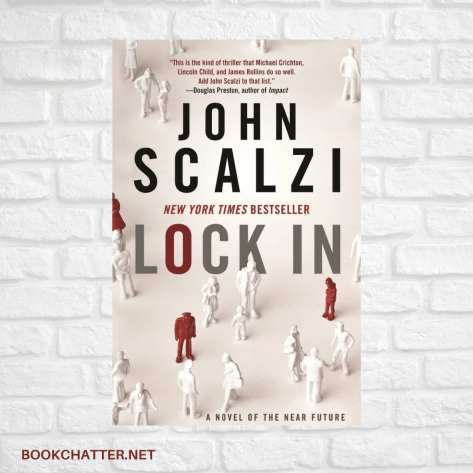
Lock In book cover.

Lock In 
By John Scalzi
Tor Science Fiction, 2015, 336pp.

The Short of It:

Interesting concept.

The Rest of It:

Not too long from today, a new, highly contagious virus makes its way across the globe. Most who get sick experience nothing worse than flu, fever and headaches. But for the unlucky one percent – and nearly five million souls in the United States alone – the disease causes “Lock In”: Victims fully awake and aware, but unable to move or respond to stimulus. The disease affects young, old, rich, poor, people of every color and creed. The world changes to meet the challenge. ~ the publisher

I went into this book club pick completely blind, with no idea what to expect, and it ended up being exactly the kind of read I needed. It’s a little strange, a little unsettling, and perfectly suited to a mood-driven reading experience, which honestly feels essential these days.

What really hooked me was the central concept: a virus that leaves people fully conscious but unable to move, forcing them to live their lives through “threeps,” robotic, humanoid bodies that act as their physical stand-ins while their real bodies remain safely tucked away. It’s a fascinating idea, but the story quickly makes it clear that “safe” is relative. Those affected by the syndrome are being targeted, and what once seemed like a solution to a global crisis becomes a new kind of vulnerability. These people are still here, still aware, and still at risk.

The narrative follows police detectives, including one who has Haden’s, which adds a compelling layer to how the world and its biases are portrayed. Society has already started deciding what’s acceptable and what isn’t, and the lines get murkier as the story unfolds. The fact that “threeps” can be damaged or destroyed, often at great personal cost to their users, raises the stakes in a way that feels both practical and deeply human.

What starts as a straightforward murder investigation expands into something much bigger, blending speculative sci-fi with a grounded, procedural feel.

I’m always drawn to stories that explore where we might be headed when things start to fall apart, and this one hits that note without feeling too far removed from reality. Maybe a little too close, at times.

Overall, it’s an engaging, thought-provoking read, and I’m looking forward to seeing what everyone else in book club takes away from it.

Source: Borrowed
Disclosure: This post contains Bookshop.org affiliate links.
Review: Do Androids Dream of Electric Sheep?

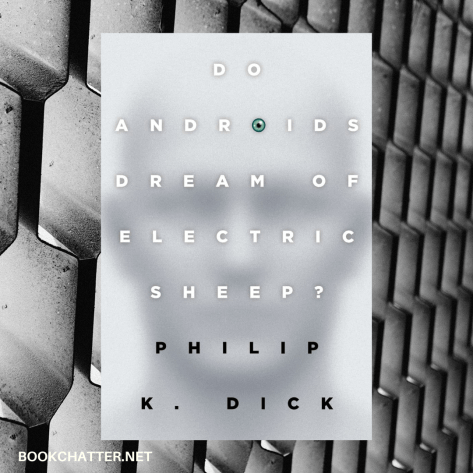
Do Androids Dream of Electric Sheep book cover. A blurred image of a face set against a metal honeycomb backdrop.

Do Androids Dream of Electric Sheep?
By Philip K. Dick
Del Rey, May 1996, 240pp.

The Short of It:

This gave me all the feels and not in a great way.

The Rest of It:

By 2021, the World War has killed millions, driving entire species into extinction and sending mankind off-planet. Those who remain covet any living creature, and for people who can’t afford one, companies built incredibly realistic simulacra: horses, birds, cats, sheep. They’ve even built humans. ~ from the publisher

What a book. It was the inspiration for the film Blade Runner in case you didn’t know but it’s quite different from the film. Living creatures are highly valued and will cost you. A simple house cat? You wouldn’t be able to afford one. Sometimes folks are lucky and can save enough for a goat or a chicken but mostly, all they can afford are simulations of said animal.

People are desperate for interaction but the Androids are so advanced that you can’t tell who is real? Bounty hunters are sent to “destroy”retire” the remaining Androids which are discovered by failing a scientific round of testing in the form of empathy measuring. But still, some of them pass because they’ve nearly become human and want to live.

This is where it gets interesting. When you are so lonely and desperate for human interaction and a droid can provide that AND show empathy in a way you haven’t seen in a really long time? How does that bode well when you are the one hired to destroy them?

I get it. I am the person who will run out of a car when I see the little DoorDash robot floundering in a busy intersection. But Ti, it’s not real. But it FEELS real and it even makes sounds like a tiny child when it’s confused. EEEEEEK. What have we become? It’s terrifying really.

First published in 1968 but so ahead of his time. The story is set in 2021 but look at us now. Talking to Siri, asking Alexa to do stuff for us and people all over conversing with ChatGPT like it’s a friend. Smart refrigerators, vacuums, and cars. I mean, you can’t even buy a car without all the stuff now.

These machines are always watching and listening. Think about that. Does the convenience outweigh the risk? Sometimes. Are we starting to cross a line? Absolutely.

During my most recent hospital stay, I could hear the AI physician talking to patients during their tele-appointments, I also had an AI Nurse that kept asking me how I was feeling. I got up out of that bed and unplugged it. NO. Just No.

Discuss. We all say, “There’s a line I won’t cross” but look at how you live today and really think about it. GPS? Useful for sure but also tracking your every move.

Discuss.

My book club will be discussing this next month. Recommend.

Source: Borrowed
Disclosure: This post contains Bookshop.org affiliate links.