
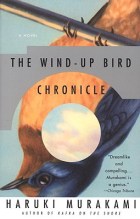
The Wind-Up Bird Chronicle
By Haruki Murakami
(Vintage, Paperback, 9780679775430, 1998, 624pp.)
The Short of It:
A wildly imaginative work. Quite possibly the most interesting literary experience I’ve had. Ever.
The Rest of It:
If I had to sum this book up with one sentence, I’d say this:
Nothing, is as it seems.
Toru Okada is a normal guy. But when his cat goes missing, and then his wife Kumiko follows shortly thereafter, what at first seems normal suddenly becomes surreal and odd. So odd, that Toru apends time in an abandoned well to sort it all out.
In the mean time, he meets a cast of very strange characters:
- May Kasahara – a young neighbor girl who thinks about death a lot. She has a very matter-of-fact way of talking and acts as a sounding board for Toru.
- Noboru Wataya – the brother of Kumiko. Toru cannot stand him as his political ideals differ from his. He’s also a bully when it comes to his sister Kumiko. The lost cat is also named after him, which is odd in and of itself given that Kumiko and Toru really do not like the guy.
- Lieutenant Mamiya – an officer who witnessed the brutal death of a another officer. He is scarred over that event and has spent his own time down in a well. He has been tasked with carrying out a request in a will which is what brings him to Toru.
- Malta Kano – acts as a medium. Kumiko hires her to help them find their cat. She sees things, but she’s not all that clear when she translates it to those who need the information.
- Creta Kano – Creta is Malta’s sister. She too, has a talent but her talent is unpracticed and involves inhabiting people’s minds. She is also called a “prostitute of the mind” and gets to know Toru quite well.
- Nutmeg Akasaka – the businesswoman who first sees Toru while observing people in the city. She is attracted to the blue\black mark on his face. A mark that her father also bore many years ago. Later, she makes him a proposition that he finds hard to refuse.
- Cinammon Akasaka – the son of Nutmeg. He does not speak but uses a strange form of sign language to communicate. He carries out the wishes of his mother but is exceptionally good at what he does and what he does involves looking out for Toru on many levels.
- The Wind-Up Bird – a bird that only certain characters hear. This bird makes a screeching noise and when Toru hears it, he is immediately reminded of a spring and how it needs to be wound in order to keep the world going. If you pay attention while reading, the appearance of the bird can clue you in to what is going on at that point in time.
There isn’t a right or wrong way to describe this book. The story is simple, but the things that happen within the story beg to be discussed. The personalities of the characters, their history and how they all play their own part in the story is what makes a Murakami book an “experience” more than just a good read. It’s walks a crazy fine line between what’s normal and what’s not and throws in bits and pieces to shake you up and to jolt you back into reality, or what you think is reality. It’s the type of book that will have you asking questions for days, but somehow Murakami manages to bring it all together by those last few pages. Not to say that your questions have been fully answered. No, can’t say that. But I can say that as a reader, I was satisfied when I turned that last page.
Murakami’s writing is very accessible and simple to follow. Most first-time readers feel intimidated by what they’ve heard about him, but the writing is not complex. The meaning behind what is written though, can boggle the mind, but not in a bad way. His books have a palate cleansing effect which I find very pleasing. He challenges you to think outside of the box and if you give in to it, usually you’re rewarded with a positive reading experience. Usually. There are those that are completely turned off by the oddness of it, and I understand that too. Murakami is not for everyone but what a reading experience it is!
Reading this book was like taking two Benadryls, drinking a couple glasses of wine and then having one heck of a strange dream afterward. You wake, but you don’t wake and you sort of like it that way.
As with his other novels, this book shares many of the same themes but mostly alienation and loneliness. There are some graphic depictions of sex and rape but not as much as some of his other novels. There is also a particularly gruesome act of violence but it’s brief and not drawn out so I found it tolerable although some of the other readers in the read-along found it hard to read.
Compared to his other books, The Wind-Up Bird Chronicle is probably one of my favorites. It’s right up there with Kafka on the Shore but I found it much easier to follow than Kafka. It’s long. Over 600 pages long but much of it reads very quickly. In the six weeks that we had to finish the book, I think most finished well before the deadline. However, it was maybe 50 pages too long. I understand that two chapters were removed from the English translation and that they had to do with Toru’s relationship with Creta. I know it would have made the book longer but I wish I had those chapters now.
If you are intrigued and want to give it a try, do so with an open mind and give yourself plenty of time to absorb what you’ve read. It also doesn’t hurt to take a week or two when done to just ponder the story. I found it very hard to focus on other books after finishing Wind-Up.
The book is made up of three books and I posted updates after finishing each book. The updates are noted below. Check them out if you decide to read the book. I sure hope you do. Reading it with 80+ people was a lot of fun, even though many of them remained silent. I felt their presence. I truly did and it was a pleasure to be a part of it. This reading also counts for the Haruki Murakami 2013 Challenge. Click on the button below for more info.
#winditup2013 Read-Along Update Posts:
Read the discussion on Twitter! Use #winditup2013!
Source: Purchased
Disclosure: This post contains Indiebound affiliate links.
 Book Chatter