
Tag Archives: Fiction

Review: Tinkers

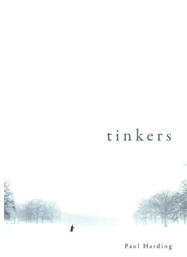
Tinkers Book Cover

Tinkers
By Paul Harding
Bellevue Literary Press
January 2009
192pp

The Short of It:

A tiny novel that packs an emotional punch.

The Rest of It:

An old man lies on his deathbed, and from it, reminisces about this childhood and his relationship with his father. Simple, yes?

Yes, but Tinkers is not an “in your face” type of story. George Washington Crosby lapses in and out of consciousness as his loved ones wait for the inevitable.  His childhood memories come and go in fleeting, almost ethereal ways. Some memories are more structured than others, but nearly all center around his father Howard, who spent a good portion of his adult life struggling with Epilepsy, which back then, was not a disease that people were familiar with.

After a particularly bad episode, one which leaves George with a bitten hand, George’s mother seeks help in treating this disease. Except, the “treatment” for such a thing back in those days involved a trip to a mental institution. Something that Howard wants no part of since his own father was taken to one when he was just a young boy.

As a tinker, Howard is used to traveling from farm to farm, selling his wares. He is no stranger to travel. So, he loads up his cart and leaves his family, for good.  What George recalls from his deathbed, are the tender moments between a father and his son, but also the darker moments of terror, not knowing or understanding what was happening to his father at the time.

This is a sad story. It has a heavy, weighty feel to it even though it’s such a short novel. Harding’s grasp of the father/son dynamic is gripping and unrelenting at times. The images he paints with words caused me to pause in thought numerous times and it’s left me mentally exhausted. That sounds like a negative comment but it’s really not. Death is an ordeal and losing a loved one certainly takes its toll and that is what it feels like. It’s as if I weathered a storm and now the clouds have passed.  There is a moment of quiet wonder. That is what I am embracing right now.

As a book club book, I think there would be a lot to discuss as far as how Harding presents his ideas, and his writing style in general, but it’s a simple story at heart. Those looking for a book that is heavy on plot, won’t find that in Tinkers, but it’s a rewarding read nonetheless.

Tinkers won the 2010 Pulitzer Prize for Fiction, and is Paul Harding’s first novel.

Source: Purchased
Review: The Girl Who Kicked the Hornet’s Nest

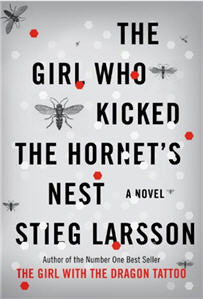
The Girl Who Kicked the Hornet's Nest (Book Cover)

The Girl Who Kicked the Hornet’s Nest
By Stieg Larsson
Knopf
May 2010
576pp

The Short of It:

The Girl Who Kicked the Hornet’s Nest is at once edgy and endearing. Edgy in that you often can’t believe what you just read, and endearing in that no matter what the main characters do or say, you still look forward to spending some time with them.

The Rest of It:

The Girl Who Kicked the Hornet’s Nest is the final book in Larsson’s Millennium Trilogy. The series is all over the internet, so I don’t feel the need to go into details over what it’s about, but for those of you who have not read any of the books, I will tell you this, it’s well-written crime fiction with a kick-ass protagonist. If you need the summary, click here to read it.

The series as a whole can be a bit graphic. There is a lot of sexual violence towards women and there’s lesbianism and some language too, but for some reason you just sort of take it all in without balking too much about it.

Since my thoughts are all over the place with this book, I am going to highlight a few items:

  • The background history on how SIS came into being (which is sort of Sweden’s version of the CIA), was interesting at times. I felt that it went on way too long though. There was just too much detail and it dragged during these parts.
  • Lisbeth is still one of my fave female protagonists. She’s complex and simple at the same time. Complex because only a few can figure her out, but as you read and really get to know her, you realize how simple her needs and wants are. She is a no-frills kind of gal. Lovers of Lisbeth might get frustrated with her lack of involvement in the first half of the novel.
  • Mikael Blomkvist is still the womanizer of books past, but he’s so damn likable and apparently very good in bed because the women just flock to him. I love his matter-of-fact style when it comes to relationships.
  • Erika Berger plays a slightly larger role in this book. I love Erika. Another strong female. I can see why Mikael and her hook-up every now and then.
  • Larsson’s use of small, insignificant details was a bit distracting this time around. Right in the middle of the story of the century, he’ll stop to describe the sandwich that Mikael makes, or the type of electronic device that Lisbeth uses (brand, model, etc.). These mundane details were out of place. I thought this especially odd since these characters are not new to the series. Plus, the mention of specific pieces of equipment sort of dates the story in my opinion.
  • There were too many “E” names and with similar spellings to boot. I had to really concentrate to keep them all straight. I found myself frustrated by this more than once.
  • The story wrapped up too quickly at the end. Another blogger reminded me that this was meant to be book three in a ten book series before the author passed away. I suppose everything had to be tied-up quickly since it was the end of the line for the series.

In the end, I felt a tad disappointed with Hornet. To me, it was the weakest book of the series but it did answer quite a few questions that were left hanging in the previous books. BUT, even with that, I still enjoyed it quite a bit and the series is definitely worth reading.

Source: This review copy was provided by the publisher.