
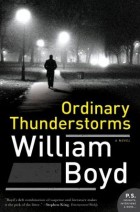
Ordinary Thunderstorms
By William Boyd
(Harper Perennial, Paperback, 9780061876752, February 2011, 432pp.)
The Short of It:
Ordinary Thunderstorms is anything but ordinary, yet it wasn’t at all what I expected it to be. I guess you could say that it caught me completely off-guard.
The Rest of It:
Adam Kindred is at the wrong place, at the wrong time and stupidly removes a knife from the side of a dying man. In a panic, he flees and takes to the streets to become a transient, begging for change. As the story unfolds, all of the complexities of what’s happened and what he’s done comes to a head. He’s lost everything and yet, he doesn’t seem to care. As the story unfolds, and the reasons for what’s happened come to light, he sets out to flush out the bad guys.
When this book came out in hardback, I added it to my to-read list because I had read an article where Stephen King said it was one of the best books he’s ever come across. I was intrigued by this for many reasons. First off, I adore King’s writing. Second, King’s opinion of what’s good can only be interesting, right? Well, I can’t speak for King, but what fascinates me about Ordinary Thunderstorms is Adam’s innate ability to adapt to the situation. In a split second he decides to give up the life he’s known with very little remorse. Stripped of his worldly possessions, he makes do with the basics and remarkably, seems happy…not at all devastated at what he’s lost. This aspect of the story intrigued me.
As a transient, he meets various people who unknowingly assist him in his desire to remain invisible. Mhouse, a prostitute with whom he lives for a very short while, her son, Ly-on, whom Adam takes a deep liking to, and various other folks he comes across including a Marine cop whom he ends up sleeping with. But, these encounters are brief and although they exist to prove that there is another side to Adam, the side that comes to the surface is not one that I particularly liked.
In the midst of all of this running, Boyd uses his novel to make a statement about big pharmaceuticals and the effect that they have upon society as a whole and Adam is right smack in the middle of it.
I thought this novel would be suspenseful and that Adam would come full circle in his discovery of who he is, but I’m not sure he ever figures that out and although parts of it were suspenseful and fast paced, much of it left a sour taste in my mouth. Had Boyd focused on one aspect of the novel, I think it would have had a bigger impact on me, but instead he dabbles in a little bit of everything in his attempt to cover it all which leaves some things underexplored.
As a suspense tale, there isn’t any big pay-off. There is, but there isn’t. Meaning, it’s not as satisfying as it should be and as an internal look at the human psyche, well, that’s less than satisfying too. Ordinary Thunderstorms is a message cushioned between the pages of what could have been a great, suspenseful read, but instead ends up being just the shell of what could have been.
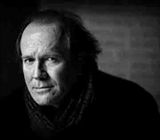
To visit William’s website, click here.
To view William’s other TLC tour stops, click here.

Source: Review copy provided by the publisher via TLC Book Tours.
 Disclosure: This post contains affiliate links.

 Book Chatter