
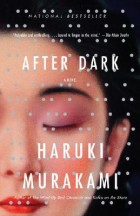
Review: After Dark

After Dark
After Dark

By Haruki Murakami
(Vintage, Paperback, 9780307278739, April 2008, 256pp.)

The Short of It:

Mesmerizing.

The Rest of It:

I don’t spend  a lot of late evenings out. But, I have been known to hit a late movie once in awhile and when I do, I am always amazed at how many people are out so late at night. It’s as if there is this whole other world from say, 11pm (late for me) to early morning. Well, After Dark is all about that. Mari is sitting alone in a Denny’s, reading her book when a young musician named Takahashi asks to sit at her table. Confused as to why a complete stranger would want to sit with her, he explains that they have met before and that he dated Mari’s sister, Eri. As the conversation continues, Mari learns that Takahashi’s band practices in a basement nearby, and that he sometimes visits Denny’s for a meal. He offers to hook-up with her again if she ever wants to, which she politely turns down.

Later that same evening, a woman by the name of Kaoru is sent to find Mari at the Denny’s, because she is in need of a Chinese interpreter. Turns out that there is a young prostitute that needs her help. Takahashi, wh0 sometimes works for Kaoru doing odd jobs around the “love hotel” remembered that Mari speaks both Japanese and Chinese and figured she’d be the perfect person to help out. As the evening plays out, Takahashi learns more about Mari and her sister Eri, who seems to have a severe sleeping problem and has been asleep for over two months straight.

What does any of this mean? Who knows? It’s the wondrous, dreamy world of a Murakami novel. There are moments of pure brilliance and moments where you aren’t quite sure what is going on, but never at any time are you bored. Out of all the Murakami novels I’ve read so far, this one probably had the least amount of action, but it left me with many questions. I caught myself thinking about these characters at odd times. Especially the sleeping sister. Was she depressed? Did she enter an alternate universe during slumber?

Needless to say, I was highly amused by this one and each time I read a Murakami novel I am left with this feeling that there is a greater something out there. I’m not talking spiritually here, but more other worldly. I think that is why I am endlessly fascinated by Murakami’s writing. If I could shrink him down and put him in my pocket, I would. That would be weird though.

Source: Purchased
Disclosure: This post contains Indiebound affiliate links.

Review: 11/22/63

11/22/63

11/22/63
By Stephen King
(Scribner, Hardcover, 9781451627282, November 2011, 864pp.)

The Short of It:

A total departure from what King is typically known for, and not at all what I expected.

The Rest of It:

Jake Epping, thirty-five and writing his first novel, teaches GED courses at the local high school so he can make a few extra bucks. He asks his students to write about an event that changed their lives. One of his students writes about the murder of his family, at the hands of his own father. Jake is blown away by his essay and can’t get those horrible images out of his mind. Days later, Al, a long-time friend, asks Jake to visit him at the diner he owns. What Jake sees before him, is a very ill man. A dying man. Quite different from when he saw him just a few days before. Al explains that he is, in fact, dying from lung cancer and needs to ask a favor or Jake. In his storeroom, Al shows him a portal to the past and asks Jake to complete the task that he is now unable to carry out; preventing the assassination of President John F. Kennedy.

The premise of this novel is so different from anything King has done before, that when I first heard about it, I immediately added it to my “want” list. Traveling back in time to change history has been done a million times before, but for some reason, I was looking forward to King’s attempt at it. Since the title of the book refers to the assassination of John F. Kennedy, I naturally assumed that the bulk of the story would center around it. However, I was wrong on that count.

Although Jake’s entire reason for entering the portal is to prevent the assassination, the story quickly takes a turn and becomes something else entirely. Much of it, almost half of the book deals with trying to prevent his student’s family from being murdered. The rest of it is about the woman he meets while living in past and then there is the assassination attempt. Had this book been advertised differently, I think I would have enjoyed it more, but I was expecting to read more about the assassination attempt and a lot less about Jake’s romantic interest.

Was the story readable? Yes, but it lacked the character development that King’s books are known for. I found myself skimming, especially through the romantic bits because I just didn’t care for any of the characters and that pains me because I am a huge King fan. All in all, I can’t recommend this one. It lacked depth, focus and the character development that I’ve come to expect from King and left me very disappointed.

Source: Purchased
Disclosure
: This post contains Indiebound affiliate links.