It’s Jake’s birthday. He is sitting in a small plane, being flown over the landscape that has been the backdrop to his life – his childhood, his marriage, his work, his passions. Now he is in his mid-sixties, and he isn’t quite the man he used to be. He has lost his wife, his son is in prison, and he is about to lose his past. Jake has Alzheimer’s.
As the disease takes hold of him, Jake struggles to hold on to his personal story, to his memories and identity, but they become increasingly elusive and unreliable. What happened to his daughter? Is she alive, or long dead? And why exactly is his son in prison? What went so wrong in his life? There was a cherry tree once, and a yellow dress, but what exactly do they mean? As Jake fights the inevitable dying of the light, the key events of his life keep changing as he tries to grasp them, and what until recently seemed solid fact is melting into surreal dreams or nightmarish imaginings. Is there anything he’ll be able to salvage from the wreckage? Beauty, perhaps, the memory of love, or nothing at all?
From the first sentence to the last, The Wilderness holds us in its grip. This is writing of extraordinary power and beauty.
I must get my hands on this one. What did you find this week?
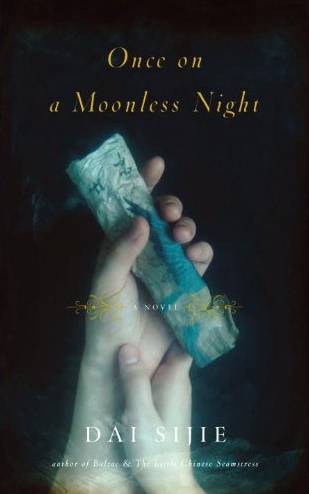
From the author of the beloved best seller Balzac and the Little Chinese Seamstress, a haunting tale of love and of the beguiling power of a lost language.
When Puyi, the last emperor, was exiled to Manchuria in the early 1930s, it is said that he carried an eight-hundred-year-old silk scroll inscribed with a lost sutra composed by the Buddha. Eventually the scroll would be sold illicitly to an eccentric French linguist named Paul d’Ampere, in a transaction that would land him in prison, where he would devote his life to studying the ineffably beautiful ancient language of the forgotten text.
Our unnamed narrator, a Western student in China in the 1970s, hears this story from the greengrocer Tumchooq—his name the same as that of the language in which the scroll is written—who has recently returned from three years of reeducation. She will come again and again to Tumchooq’s shop near the gates of the Forbidden City, drawn by the young man and his stories of an estranged father. But when d’Ampere is killed in prison, Tumchooq disappears, abandoning the narrator, now pregnant with his child. And it is she, going in search of her lost love, who will at last find the missing scroll and discover the truth of the Buddha’s lesson that begins “Once on a moonless night . . .” in this story that carries us across the breadth of China’s past, the myth and the reality.




 Book Chatter